

Tokenmaxxing is over. Measure the work instead.
Tokenmaxxing is ranking and rewarding people by how many AI tokens they burn. In 2026 it hit a wall: Meta's token leaderboard came down in April, Amazon's in May, and in October an Amazon memo called token counts "deeply flawed" as a measure of AI work. Caps came next, and they count the same thing. What replaces both is the cost of finished work: per ticket, by kind of work.
- tokenmaxxing noun, 2026
- "An informal term for the organizational practice of incentivizing employees to maximize their AI token usage, typically as a means to encourage experimentation with AI tools and automation of everyday tasks."IBM, What is tokenmaxxing?, 1 Sep 2026. Also used for the people who inflate their usage to climb a leaderboard.
How tokenmaxxing rose and fell in 2026
From "spend half a salary on tokens" to caps of $200 a day in eight months. Each event links to the outlet that reported it.
- NvidiaMore tokens
Spend half a salary on tokens
Jensen Huang said on a podcast he would be "deeply alarmed" if a developer on a $500,000 salary did not spend at least $250,000 a year on tokens.
IBM - MetaPull back
The Claudeonomics board goes dark
An internal leaderboard of Meta's top 250 token users, with titles like "Token Legend", showed more than 60 trillion tokens in 30 days. The employee who built it took it down. Meta says it did not ask.
Fortune - A manager on Hacker NewsPull back
Usage doubled, output did not
After a token dashboard went public at their company, "just about everyone's usage went up by 100%-200% almost immediately", with no increase in output. Unlimited use became a $600 monthly budget.
Hacker News - AmazonPull back
Kirorank goes offline
Managers found staff "creating AI agents to carry out unnecessary tasks" to climb an unofficial usage leaderboard. A senior VP said it was built "with good intentions" but the compute cost was too high.
CIO, citing the FT - UberPull back
A cap per tool
All employees limited to $1,500 a month per AI coding tool, after the CTO said the planned budget was "blown away already".
Bloomberg - MetaPull back
"A token incinerator"
Instagram head Adam Mosseri: "It's not that hard to build a token incinerator, and that doesn't create a lot of value." He expects per-engineer caps within a year or two.
TechCrunch - AmazonPull back
The memo against tokenmaxxing
Token usage, AI tool adoption and code-change counts are "deeply flawed" ways to measure AI work. "If your work does not benefit from current AI tooling, that is a finding, not a failing." Amazon says it has not capped token usage.
The Next Web - ApplePull back
From $300 to $200 a day
Some engineers' daily AI cap was cut from $300 to $200, with $100 possible for some teams. Sources said few used the full $300.
MacRumors
Why token counts fail as a measure
- Tokens are what the work cost, not what it didA token count is a meter on the input. Two people can close the same ticket with ten times different token counts, and the cheaper one is not lazier.
- Anything you rank, people inflateAmazon found staff creating AI agents to carry out unnecessary tasks to climb Kirorank. Goodhart's law, in compute.
- Tokens do not even track the billModel choice and cached input change the price of a token many times over. Rank people by tokens and by dollars and you get two different lists.
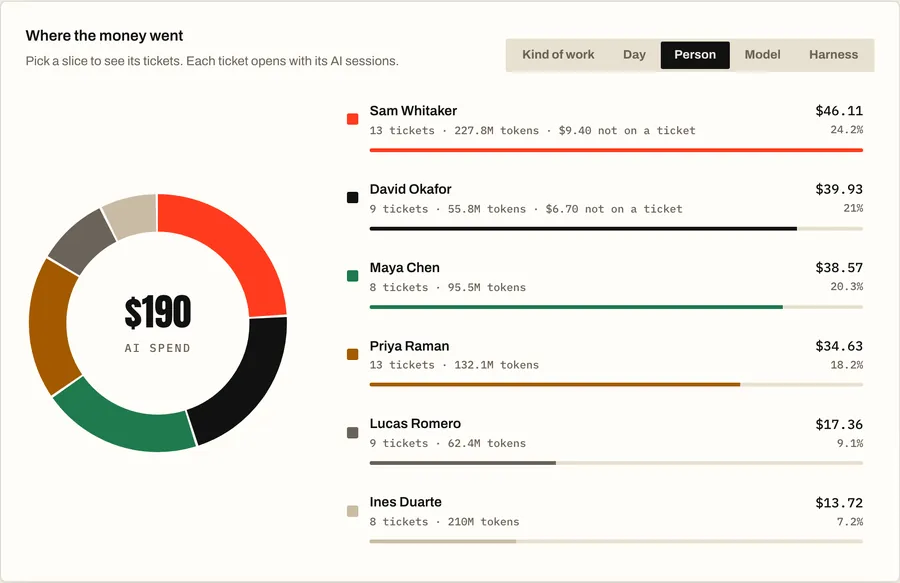
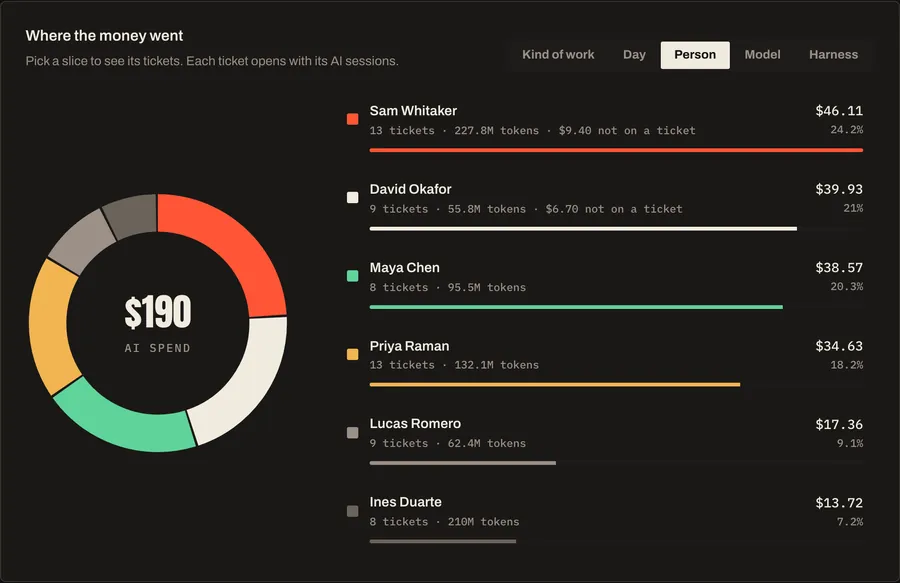
The same six people ranked two ways. By tokens: Sam Whitaker 227.8M, Ines Duarte 210.0M, Priya Raman 132.1M, Maya Chen 95.5M, Lucas Romero 62.4M, David Okafor 55.8M. By dollars: Sam Whitaker $46.11, David Okafor $39.93, Maya Chen $38.57, Priya Raman $34.63, Lucas Romero $17.36, Ines Duarte $13.72.
Demo workspace, November 2026, from the screen below. Ranks in red move two places or more between the lists.
Switch the ranking above. These are the six people in the Jenzo demo workspace. By tokens, Sam Whitaker leads and Ines Duarte is second, with 210M tokens. By dollars, Ines Duarte is last, at $13.72 for the month. One leaderboard makes Ines the second heaviest AI user on the team. The other makes Ines the cheapest. Neither says what any of them got done. Ranking people by dollars instead of tokens just builds a new leaderboard.
The overcorrection: caps
When the leaderboards came down, budgets came in. Uber capped each AI coding tool at $1,500 a month. Apple cut some engineers from $300 to $200 a day. Mosseri expects per-engineer caps at Meta. All of them are tracked in our AI spend caps tracker.
A cap counts the same thing a leaderboard counts, dollars per person, and only flips the sign. The manager on Hacker News whose team went from unlimited use to a $600 monthly budget saw it right away:
Can we hold that ticket until the end of the month? I don't want to burn through all my tokens this early in the month.An engineer in sprint planning, about a large migration ticket, as told by their manager, 9 May 2026, Hacker News
Our top user is at 10k a month, but the next highest is $2,000.An engineer at a company under 300 people, 10 Jun 2026, Hacker News
Token leaderboards were cool when the spend wasn't a double-digit-percent of the entire department's budget including salaries.On the Claude Opus 4.8 launch thread, 28 May 2026, Hacker News
A migration held back to save a personal budget is tokenmaxxing in reverse. The fix for both is the same: put the cost next to the work it bought, and judge the work.
What to measure instead
Five measures, all tied to finished work. The Amazon memo's rule applies to each one: if teams treat these numbers as targets rather than measures, they break. Read them each week. Do not rank people by them.
Cost per finished ticket, by kind of work
Is a bug fix getting cheaper or dearer?
AI spend on tickets closed this month, divided by those tickets, for each kind of work
Split work into tiny tickets. Read it next to the ticket count for each kind.
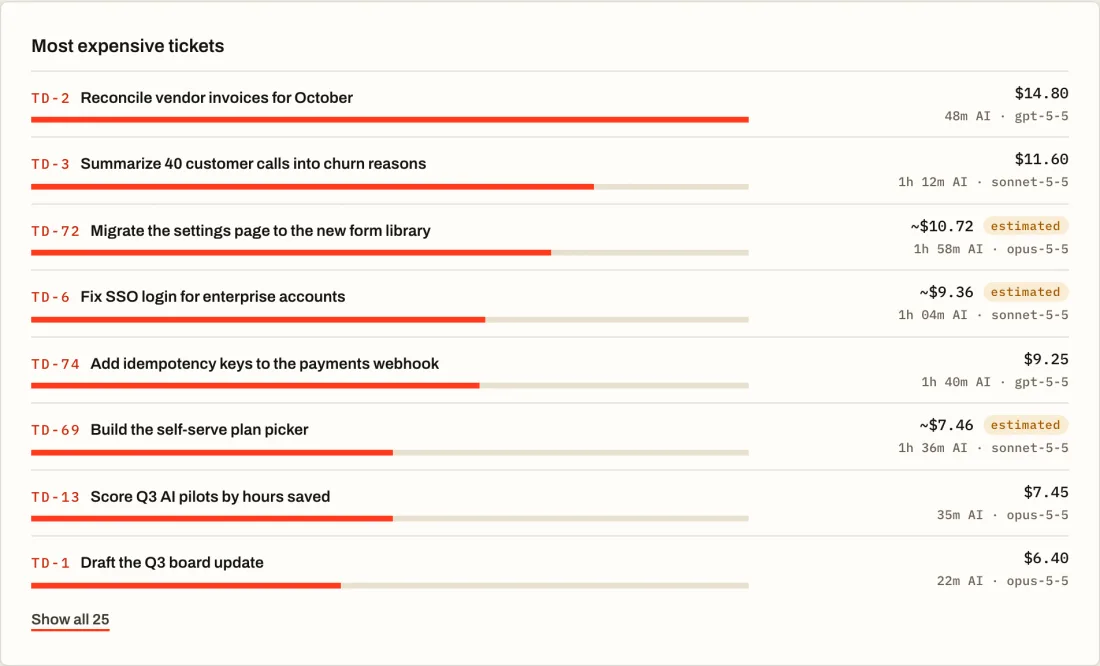
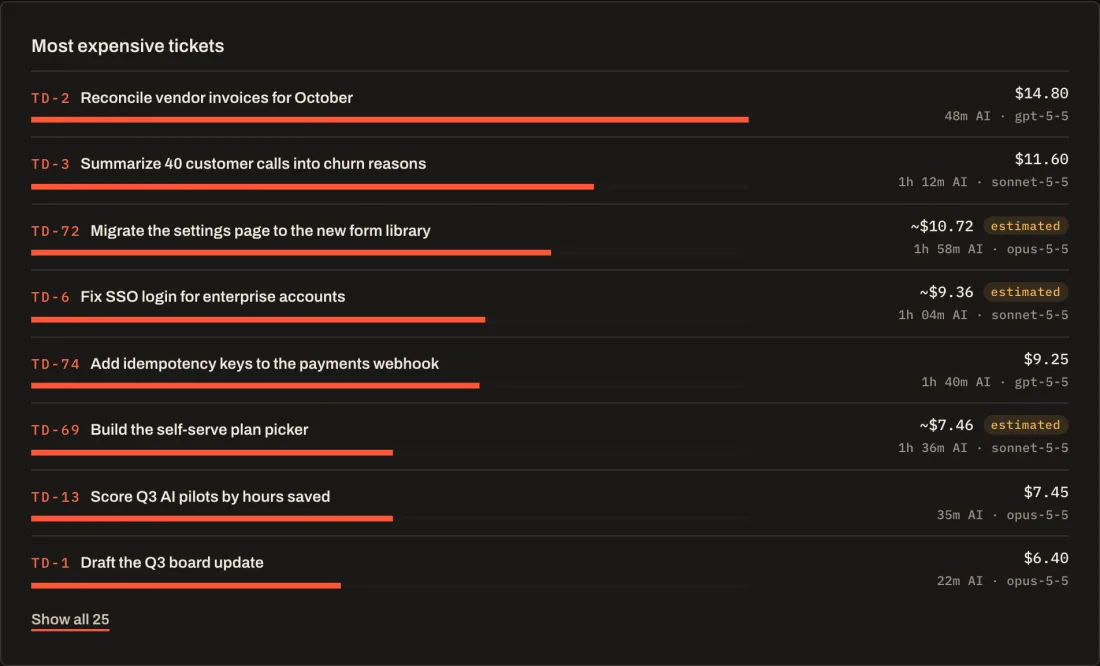
The most expensive tickets this week
Where did the money go, and was it worth it?
Sort tickets by AI cost and read the top ten
Hard to game: it is a list to read, not a score.
Share of AI spend on no ticket
How much spend can nobody explain?
AI spend with no ticket attached, divided by all AI spend
Log everything to one catch-all ticket. Look at what lands there.
Top-model spend on routine work
Are we paying frontier prices for small fixes?
Spend on top-tier models for the light kinds of work
Relabel the kind of work. Spot-check the tickets.
Rework after AI work
Did the cheap ticket come back?
Tickets reopened, or followed by a fix ticket, within 30 days of closing
File a new ticket instead of reopening. Link fixes to what they fix.
Keep the token count for finance. It is still what the bill is made of, and it is useful for forecasting. It just never answers "was this worth it?". For the full CFO view, see AI spend management in 7 numbers, and for the method behind the first measure, AI cost per ticket. To compare teams on what they get from each token, see output per token.
Where these numbers come from in Jenzo
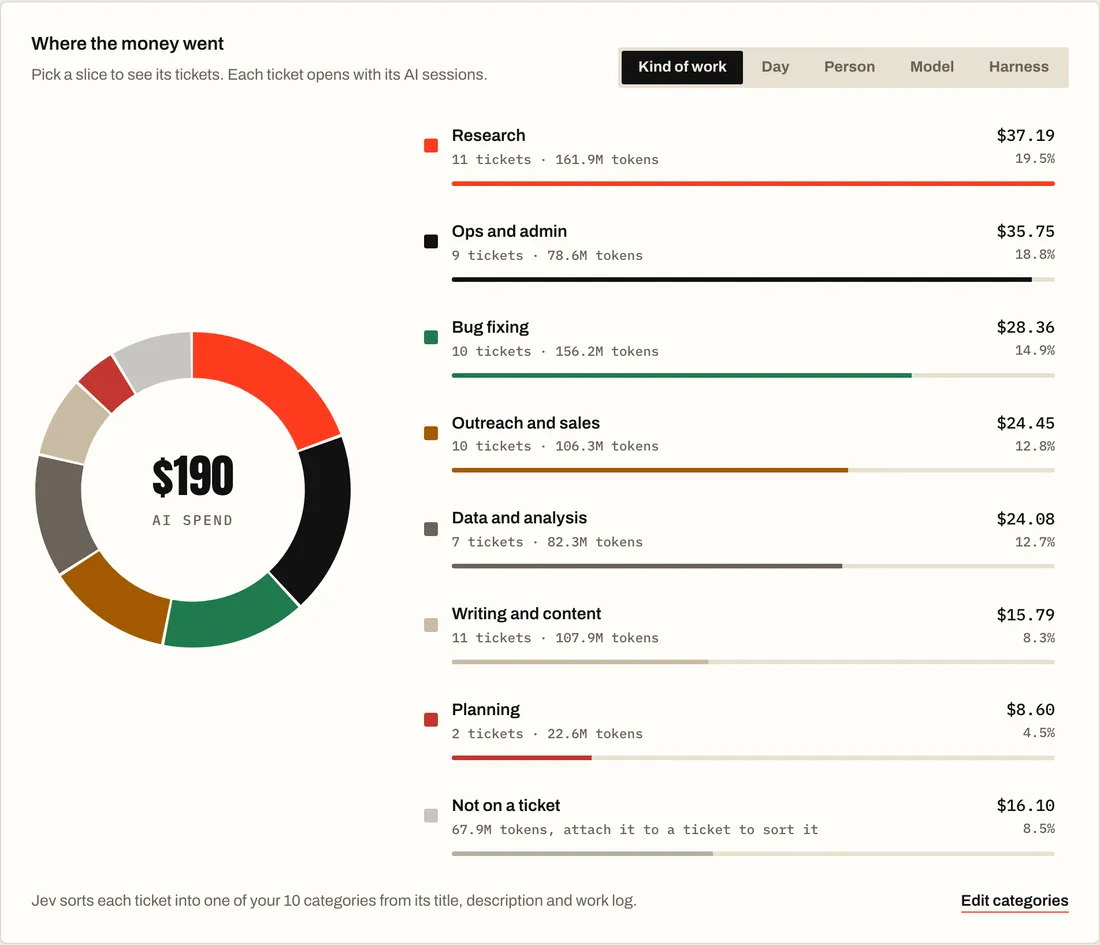
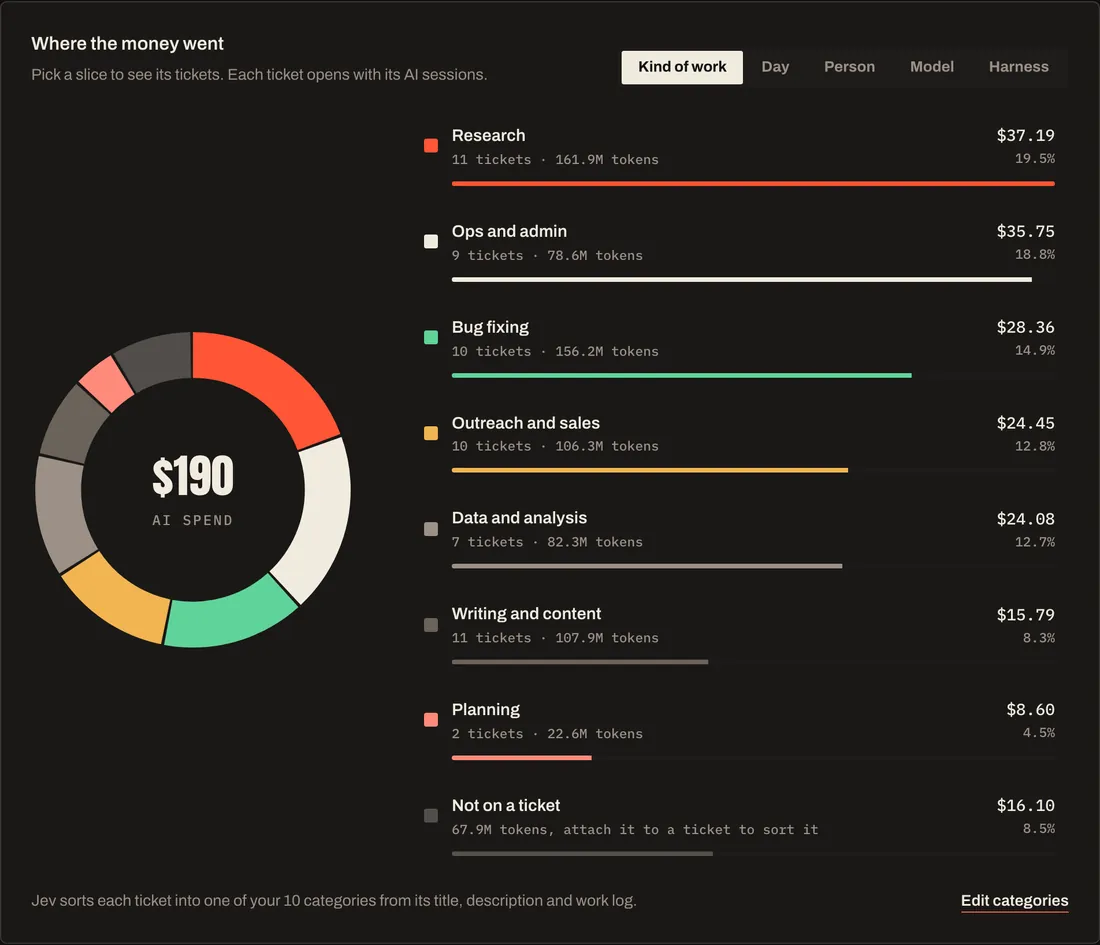
Jenzo is a ticket tracker that logs every Claude Code, Codex and Cursor session on the ticket it worked on, with tokens, model and list-price cost. Cost per ticket, spend by kind of work, the most expensive tickets and the spend on no ticket are screens you read, not reports you build. Claude Code and Codex costs are measured. Cursor costs are estimated from the tokens each session reports, and labelled that way.
Sources and method
Every event in the timeline was read on the cited page on 24 November 2026. Uber and Apple come from our caps tracker, where each cap links to the outlet that reported it. The Amazon Kirorank details are CIO's report of a Financial Times story. Meta's leaderboard figure (more than 60 trillion tokens in 30 days) is Fortune's, citing The Information. We found no reliable first use of the word, so we give no origin date.
Hacker News quotes were checked word for word on Hacker News. The token and dollar ranking uses the six people on the public Jenzo demo workspace's by-person screen for November 2026, read off the screen shown. It is demo data, not a benchmark and not Jenzo customer data.
Cite this page
Jenzo Research (2026). Tokenmaxxing: what it is, why it failed, and what to measure instead. https://jenzo.ai/research/tokenmaxxing (updated 24 November 2026).
Free to quote with a link to this page.
Questions
What is tokenmaxxing?
Tokenmaxxing is pushing people to use as many AI tokens as possible, usually through leaderboards and usage targets, on the idea that more tokens means more AI work. IBM defines it as "the organizational practice of incentivizing employees to maximize their AI token usage". The word is also used for the people who inflate their usage to climb those boards.
Why is tokenmaxxing a problem?
Tokens measure what AI work costs, not what it gets done, and they are easy to inflate. At Amazon, managers found staff creating AI agents to carry out unnecessary tasks to climb a usage leaderboard. One manager on Hacker News saw usage rise 100% to 200% after a token dashboard went public, with no increase in output.
Which companies stopped tokenmaxxing?
Meta's internal Claudeonomics leaderboard was taken down in April 2026 by the employee who built it. Amazon's Kirorank leaderboard went offline in May, and on 27 October 2026 an Amazon memo called token usage, adoption and code-change counts "deeply flawed" measures of AI work.
Is tokenmaxxing over?
The leaderboards are coming down, but many companies swung to caps instead: Uber at $1,500 a month per AI coding tool, Apple at $200 a day for some engineers. A cap still counts dollars per person, so it has the same blind spot. Neither says what the money got done.
What should companies measure instead of tokens?
Measure the work: cost per finished ticket by kind of work, the most expensive tickets each week, the share of AI spend that lands on no ticket, top-model spend on routine work, and rework after AI work. Use them as measures to review, not as targets to rank people by.
Do AI token caps fix tokenmaxxing?
They stop the bill from growing, and can create the opposite problem. One engineer asked to hold a large migration ticket until the end of the month to save their token budget. A cap tied to the ticket's value works better than a cap per head. See every 2026 cap in our AI spend caps tracker.