

AI budget per engineer
The tool makers' own averages put AI coding at $100 to $250 per developer a month: $150 to $250 for Claude Code (Anthropic), $100 to $200 for Codex (OpenAI). Company caps sit far above that, up to $4,200 a month at Apple. Every one of these numbers is an average or a ceiling, and spend inside a team is lopsided: at Accenture, 19% of users made about 80% of one tool's spend. So budget by the work, not by the head.
Every published number, per month
What AI coding costs per engineer, as the people who publish it say it, turned into one monthly figure so you can compare. Red dots are company caps. Red bars are the tool makers' own averages. The scale is logarithmic, because the numbers run from $19 to over $4,000.
| Publisher | What it is | As published | Per month | How we got per month | Link |
|---|---|---|---|---|---|
| Price index | Seat price | Team seats from $19 to $125 per user a month, top personal plans $200 | $19 to $125 | List price, monthly billing | Jenzo price index |
| StackSpend | Planning estimate (vendor) | "roughly $20 to 60 per month for a light user ... $60 to 200 for a moderate daily user, and $300 to 800 or more for a heavy agentic user" | $20 to $800 | As published | Source |
| OpenAI | Tool maker's average | "On average, Codex costs approximately $100 to $200 per developer per month" | $100 to $200 | As published | Source |
| Anthropic | Tool maker's average | "around $13 per developer per active day and $150 to 250 per developer per month, with costs remaining below $30 per active day for 90% of users" | $150 to $250 | As published | Source |
| Anthropic | 90th percentile day | Below $30 per active day for 90% of users | $630 | $30 x 21 working days, if every day is active | Source |
| Tesla | Company cap | $200 a week per employee | $867 | 52 weeks / 12 | Our caps tracker |
| Larridin | Spend benchmark (vendor) | Median $213 per engineer per week (about $920 a month), about $3,640 a month at the 90th percentile | $920 to $3,640 | The page's own monthly figures | Source |
| Uber | Company cap | $1,500 a month per AI coding tool, all employees | $1,500 | As reported | Our caps tracker |
| Apple | Company cap | $200 a day for some engineers, down from $300 | $4,200 | 21 working days | Our caps tracker |
How to read the range
Seat prices are the floor, not the cost. A $19 to $125 seat buys a usage allowance. Heavy users run past it into usage credits or API-priced tokens, which is where the averages above come from.
The tool makers' averages are the most useful anchor. Anthropic and OpenAI see every token, and both land between $100 and $250 a month. Both also say the spread is wide: OpenAI says costs "vary significantly", Anthropic tells teams to run a pilot and set a baseline before rolling out.
Benchmarks from spend tools run higher. Larridin's median is about $920. Read it as one vendor's sample, not a market average.
Caps are ceilings, not budgets. A cap is what nobody may pass, set after a bill shock. Apple's sources said few engineers used their full daily limit. See every cap and its source in our AI spend caps tracker.
Why the average lies
Each published average hides the same shape. A few people spend a lot, most spend a little, and the average describes almost nobody. Three published data points show it:
Anthropic, Claude Code
The average active day costs about $13. The 90th percentile day goes up to $30. A top decile at more than twice the average means a long tail of heavy days.
Claude Code costs docsLarridin benchmark
Median billed spend is about $920 an engineer a month. The 90th percentile is about four times that. Larridin sells AI spend measurement, so read it as a vendor benchmark.
LarridinAccenture, via Fortune
In one internal analysis, usage of a single AI tool grew 113-fold in 10 weeks, with 19% of users accounting for roughly 80% of the spend.
Fortune, 29 Jul 2026What that does to a per-head budget
Take the Accenture ratio and put it on a 10-person team that spends $2,000 a month. About two people make 80% of the spend. This is arithmetic, not data from a real team:
- The budget fits nobody. $200 a head is four times what eight people use and a quarter of what two people use.
- Cut it and you hit the wrong people. The two heavy users are often on the hardest work. A lower per-head number lands on them first, and saves nothing on the other eight.
- The average hides the question. Is $800 a month for that work cheap or wasteful? Only the tickets can say.
What engineers say about per-head budgets
We've had our AI budget per Engineer cut twice now since the peak mania in early 2026 ...On the FT story "Companies rein in AI usage as costs strain budgets", Hacker News
Most engineering teams I've talked to have no idea what their AI spend is per developer because it's buried in a consolidated cloud bill.On Simon Willison's post about Uber's $1,500 a month limit, Hacker News
Token leaderboards were cool when the spend wasn't a double-digit-percent of the entire department's budget including salaries.On the Claude Opus 4.8 launch thread, Hacker News
What happens when your budget goes from 2k/mo to 200 per eng?Quoted in the thread "AI usage generates a fragile codebase", Hacker News
Budget by the work instead
A migration and a typo fix should not share a number. What a team needs next month depends on the work it plans to do, so price the work:
- Measure one monthLog every AI session against the ticket it worked on. Anthropic gives the same advice: start with a pilot and set a baseline before a wider rollout.
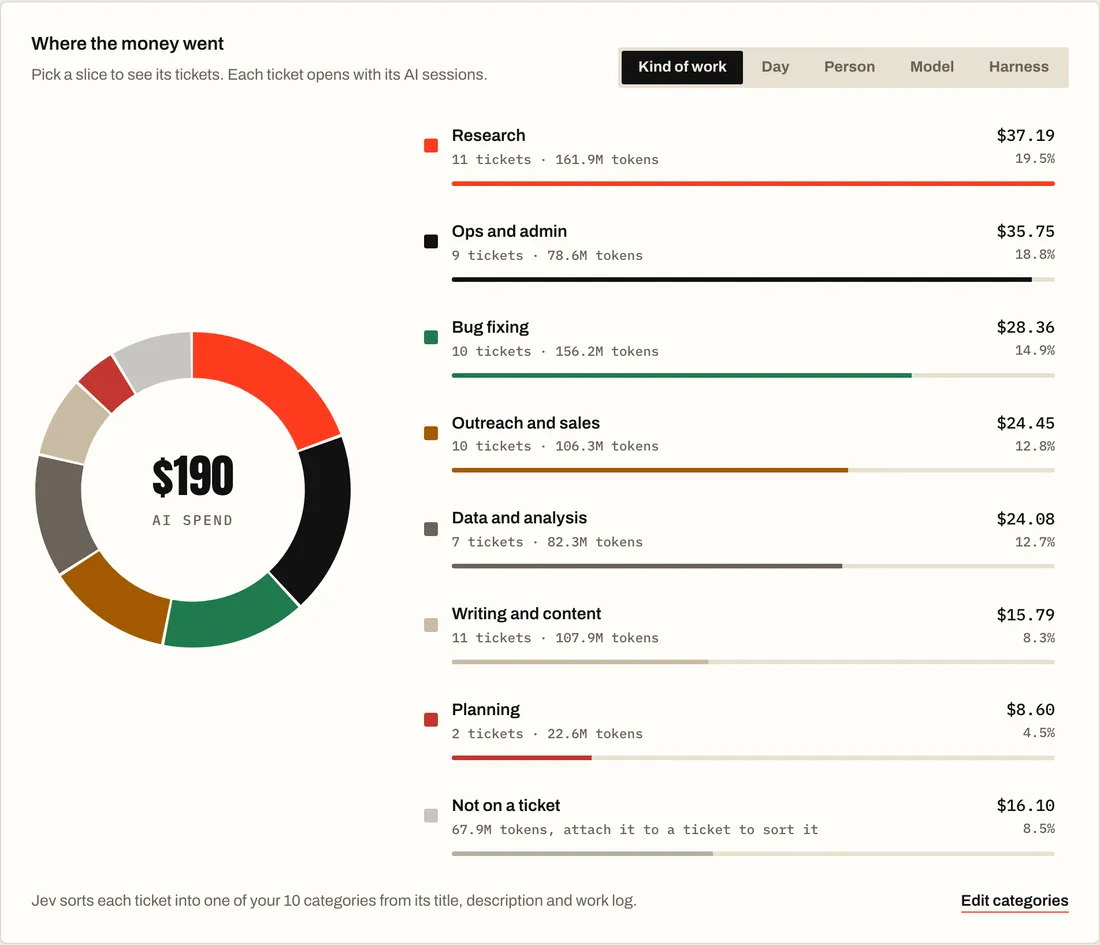
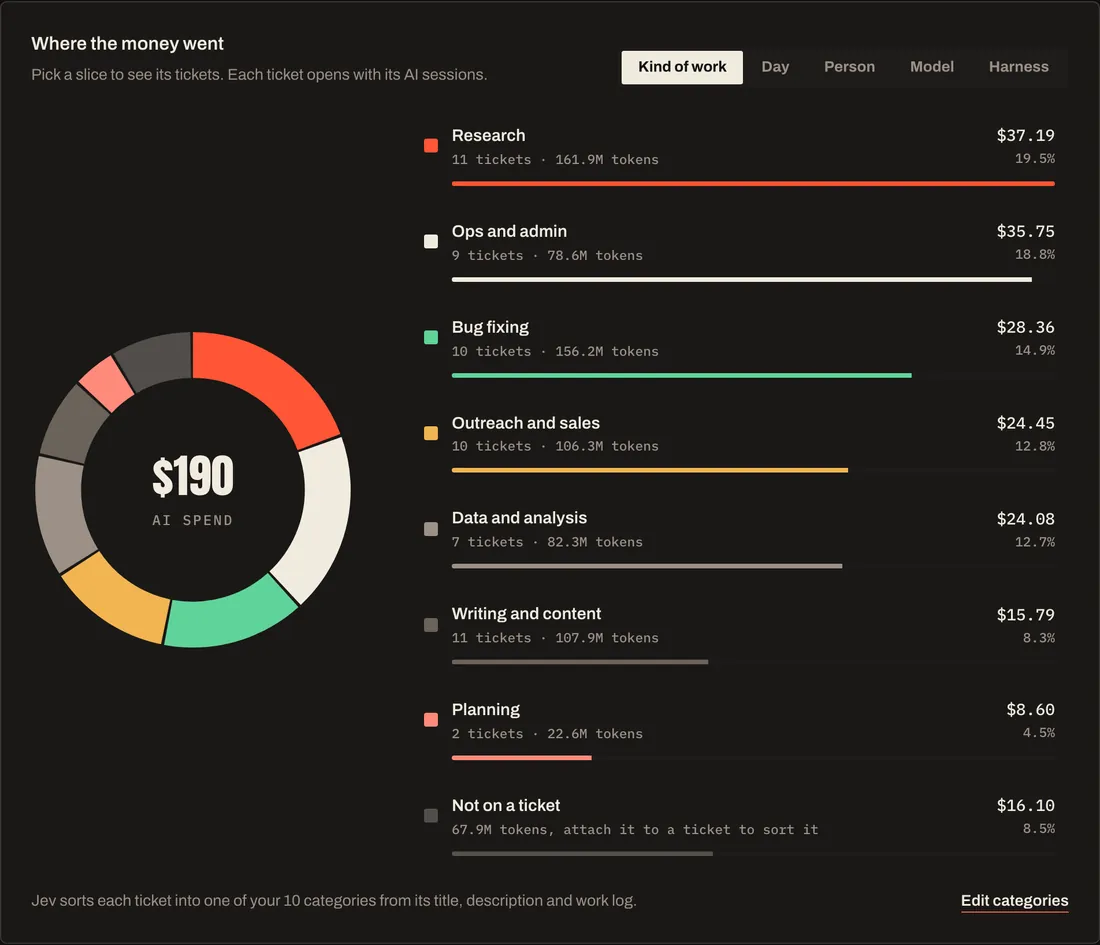
- Get cost per ticket, by kind of workBug fixes, features, migrations, research, ops. Each kind has its own typical cost. See AI spend by type of work.
- Price next month's planTickets planned of each kind, times what one cost last month. Then add the share of AI spend that landed on no ticket, or the budget will come up short.
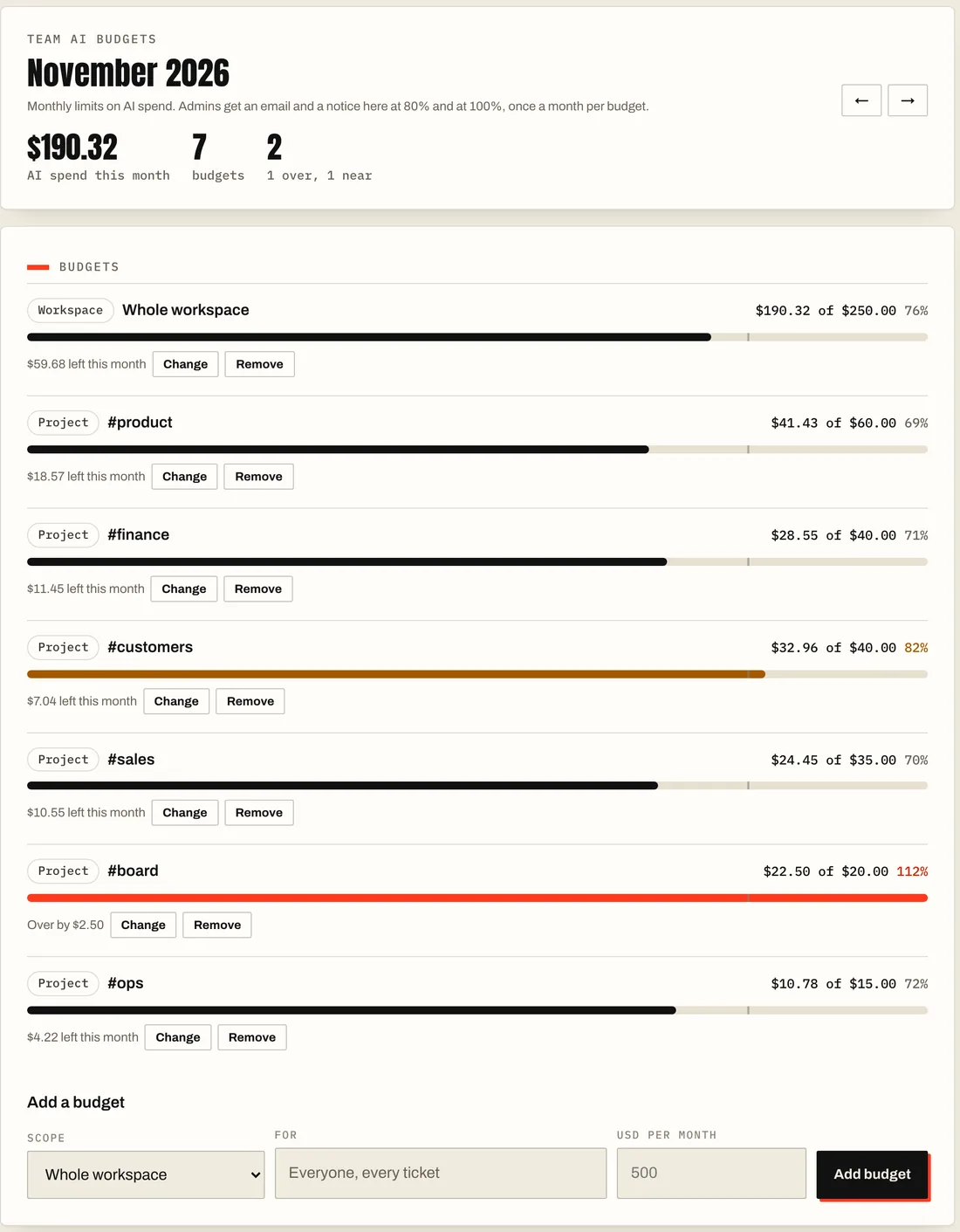
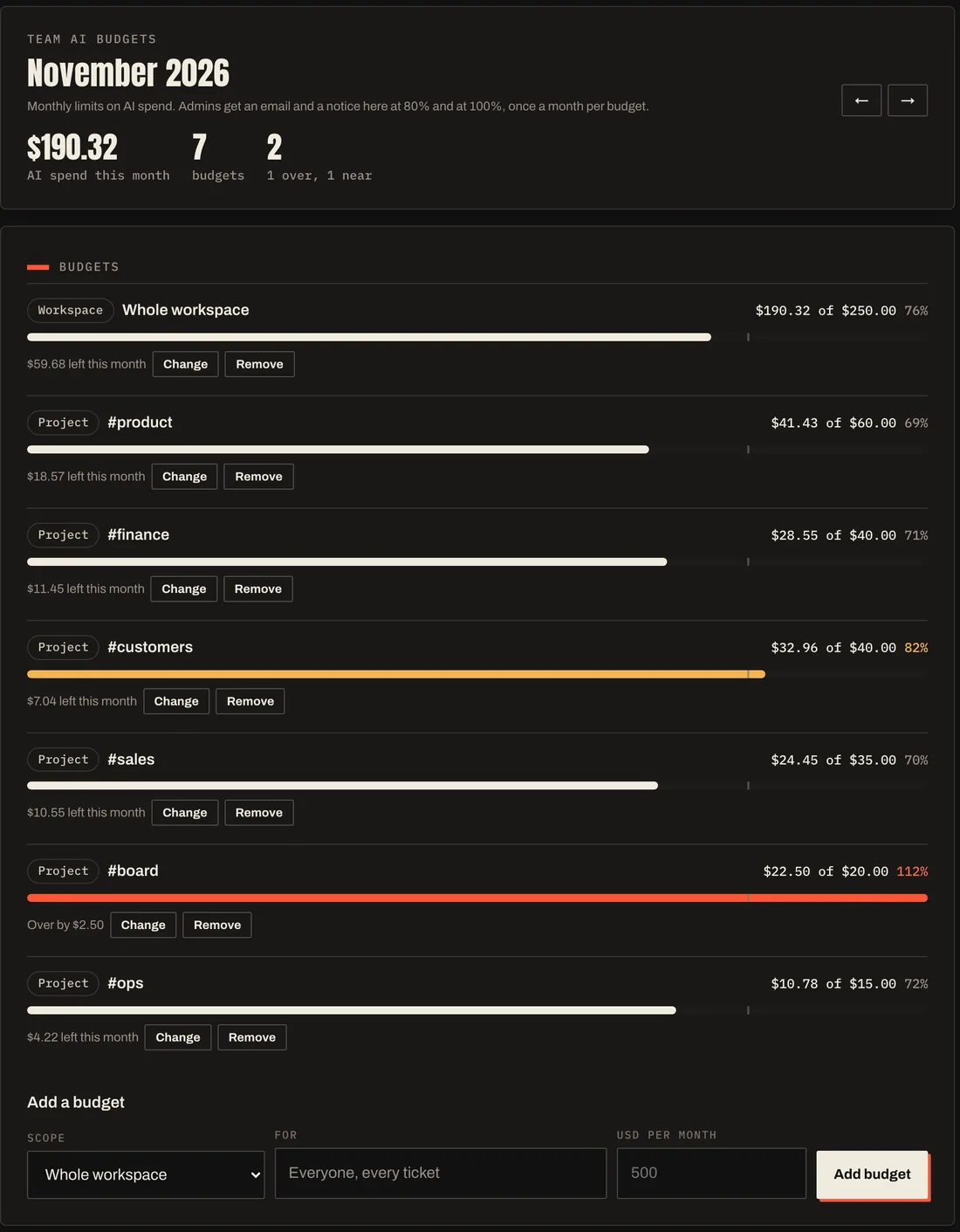
- Set ceilings from that, per project and per personWith alerts before the limit, not just at it. Exemptions point at a ticket, so anyone can judge them.
- Review the top tickets each weekNot the top spenders. The most expensive tickets show waste and value in one list, and a ranking of people turns into a leaderboard.
AI budget worksheet
Put in the kinds of work your team plans next month, how many tickets of each, and what one cost last month. The budget follows the work. The per-engineer figure is there only to compare with the published numbers above.
Includes $0 for AI work on no ticket.
$0
Set the ceiling from this, per project and per person, then check it each month against what the tickets really cost.
Where the inputs come from
Jenzo logs every Claude Code, Codex and Cursor session on the ticket it worked on, with tokens, model and list-price cost. The Spend view sorts it by kind of work, so cost per ticket by kind is a number you read, not one you build. Budgets are set per workspace, person, project or ticket, with alerts at 80% and 100%. Claude Code cost is measured. Codex and Cursor costs are estimated from the tokens each session reports, and labelled that way. More in AI cost per ticket and the CFO's view in AI spend management.
Methodology
What we include
Figures for AI coding spend per engineer or developer that a tool maker, a benchmark publisher or a company cap report states in dollars. We leave out survey averages for all AI spend per employee, because they mix chat seats with coding tools.
Sources
Every quote was checked on the publisher's own page on 22 November 2026. Larridin and StackSpend sell AI spend tools, and we say so in the table. Larridin's page gives two 90th percentile figures (about $3,640 and about $3,900 a month); we use the lower. Caps come from our caps tracker, where each one links to the outlet that reported it. The Accenture figure is Fortune's report of an internal Accenture analysis of one tool.
Per month
Daily figures are multiplied by 21 working days and weekly figures by 52 weeks divided by 12. Anthropic's 90th percentile is a daily ceiling, so the monthly figure assumes every working day is an active day. That makes it an upper bound.
The 10-person team and the worksheet
The team is the Accenture ratio applied to round numbers. The worksheet starts from example inputs. Neither is data from a real team, and neither uses Jenzo customer data. The screens are from the public Jenzo demo workspace.
Updates
We re-check the quotes when we update the page, and the seat prices follow the weekly price index.
Cite this page
Jenzo Research (2026). AI budget per engineer in 2026: the published numbers. https://jenzo.ai/research/ai-budget-per-engineer (updated 22 November 2026).
Free to quote with a link to this page.
Questions
What is a typical AI budget per engineer in 2026?
The tool makers' own averages are $150 to $250 per developer a month for Claude Code (Anthropic) and $100 to $200 for Codex (OpenAI). Team seats list at $19 to $125 a user. One vendor benchmark (Larridin) puts the median at about $920 a month and the 90th percentile at about $3,640. Company caps run from about $867 a month (Tesla) to $4,200 (Apple's engineer cap over 21 working days). Use these as a range, not as your budget.
How much does Claude Code cost per developer?
Anthropic's documentation says that across enterprise deployments the average is around $13 per developer per active day and $150 to $250 per developer per month, with costs below $30 per active day for 90% of users. That is API-priced usage. Subscription seats are a flat price per user instead.
How much does OpenAI Codex cost per developer?
OpenAI's rate card for Business and Enterprise says that on average Codex costs about $100 to $200 per developer per month, and that actual costs vary a lot with the model, the number of instances running at once, automations and fast mode.
Should every engineer get the same AI budget?
No. Spend inside a team is lopsided. Fortune reported that at Accenture 19% of users accounted for roughly 80% of one AI tool's spend. An equal budget per head is too high for most people and too low for the few doing the heaviest work. Budget by the kind of work instead, and set person or project ceilings from that.
How do I set an AI budget for an engineering team?
Measure one month first. For each kind of work, take the number of tickets you plan and multiply by what one ticket of that kind cost last month. Add the share of AI spend that landed on no ticket. That total is the budget. Then set ceilings per project and per person with alerts, and review the most expensive tickets each week.
What is the difference between an AI budget and an AI spend cap?
A budget is what you plan to spend and why. A cap is a hard limit per person and period, like Apple's $200 a day. Caps stop the bill from growing but cannot tell you what the money bought. Our AI spend caps tracker lists every company cap reported in 2026.