

The AI spend
cap wave
In October, Apple cut some engineers' daily AI budget from $300 to $200, Bloomberg reported on 4 November. Uber and Tesla capped earlier this year, and Meta says caps are coming. Here is every cap on record, sourced and dated, and why a cap answers the wrong question: it shows who spent, not what the spend got done.
Every cap on record
Company AI spending limits reported in 2026, with the outlet that reported each one. Where a report conflicts with another, the status column says so.
| Reported | Company | What changed | Limit | Per month | Status | Sources |
|---|---|---|---|---|---|---|
| 4 Nov 2026 | Apple | In October, some engineers were cut from $300 to $200 a day of AI spending, covering Claude, ChatGPT, Gemini and other models. Some may drop to $100. Many non-engineering groups were already at $100, and $25 a day is mentioned for some teams. Some teams were asked to move to cheaper or on-device models. Exemptions go through senior leadership. | $200 a day | $4,200 | Reported by Bloomberg | MacRumors9to5Mac |
| 28 Oct 2026 | Amazon | New guidelines call token usage, AI tool adoption and code-change counts "deeply flawed" ways to measure AI work. A spokesperson told CNBC that Amazon has not capped employees' token usage. An internal token leaderboard was closed in May after staff inflated their usage. | No cap, per Amazon | – | Reported (404 Media reported limits in July) | The Next WebCIO |
| 14 Jul 2026 | Meta | Instagram head Adam Mosseri on token budgets: "you're going to probably need to put in some caps." In April, an internal token dashboard called Claudeonomics went dark. Meta says the employee who built it took it down. | Caps floated | – | On the record | TechCrunchFortune |
| 2 Jul 2026 | Tesla | A $200 a week limit on staff AI spending from 6 July, with manager sign-off above it. Beta versions of xAI products are excluded. | $200 a week | $867 | Reported by The Information | FourWeekMBA |
| 2 Jun 2026 | Uber | All employees limited to $1,500 a month in token spending per AI coding tool. Earlier, CTO Praveen Neppalli Naga had told The Information that the budget he planned for was "blown away already". | $1,500 a month per tool | $1,500 | Reported by Bloomberg | BloombergSimon Willison |
What the caps allow in a month
Daily and weekly caps are hard to compare, so here they are as a monthly ceiling, if someone used the full amount. Even after the cut, a month of Apple's engineer cap is 21 times the list price of the most expensive Claude, Cursor or Devin plan. These limits are not rationing a $20 tool. They ration heavy, metered use.
The same four steps, company after company
Mandate
Leaders push AI use. Adoption becomes a goal in itself.
Leaderboard
Token use turns into a score. Amazon closed its internal leaderboard in May after staff inflated usage, and Meta's Claudeonomics dashboard went dark in April.
Bill shock
Uber's CTO said the AI budget he planned for was "blown away already". Accenture's chief AI and data officer: "My token cost from cloud code is shooting through the roof."
The cap
Uber in June, Tesla in July, Apple in October. Spend gets a ceiling per person and per period.
Few were using their full $300 daily limit.Bloomberg's sources on Apple, via MacRumors
What a cap can see, and what it cannot
Read that Apple line again. If few people used the full $300, the old cap bound almost no one, and the cut lands on the heavy users. Some of them are your best engineers doing your hardest work. Some are running the most expensive model on a typo fix. A daily dollar figure cannot tell them apart. That is the whole problem with a cap: it is a number about people and days, and the value is in the work.
A cap sees
- Who spent
- How much
- On which day
- Who asked for an exemption
A cap cannot see
- Which ticket the money went to
- What kind of work it was: a bug, a migration, a board deck
- Whether that work shipped
- Whether a smaller model would have done the same job
- AI work that never reaches git: planning, research, ops, chat
Measure these five numbers instead
Amazon's own guidelines call token counts and adoption rates "deeply flawed" measures. We agree, and a cap is the same measure with a ceiling on it. These five numbers tell you what the spend bought. Get them first, and any cap you set afterwards rests on data.
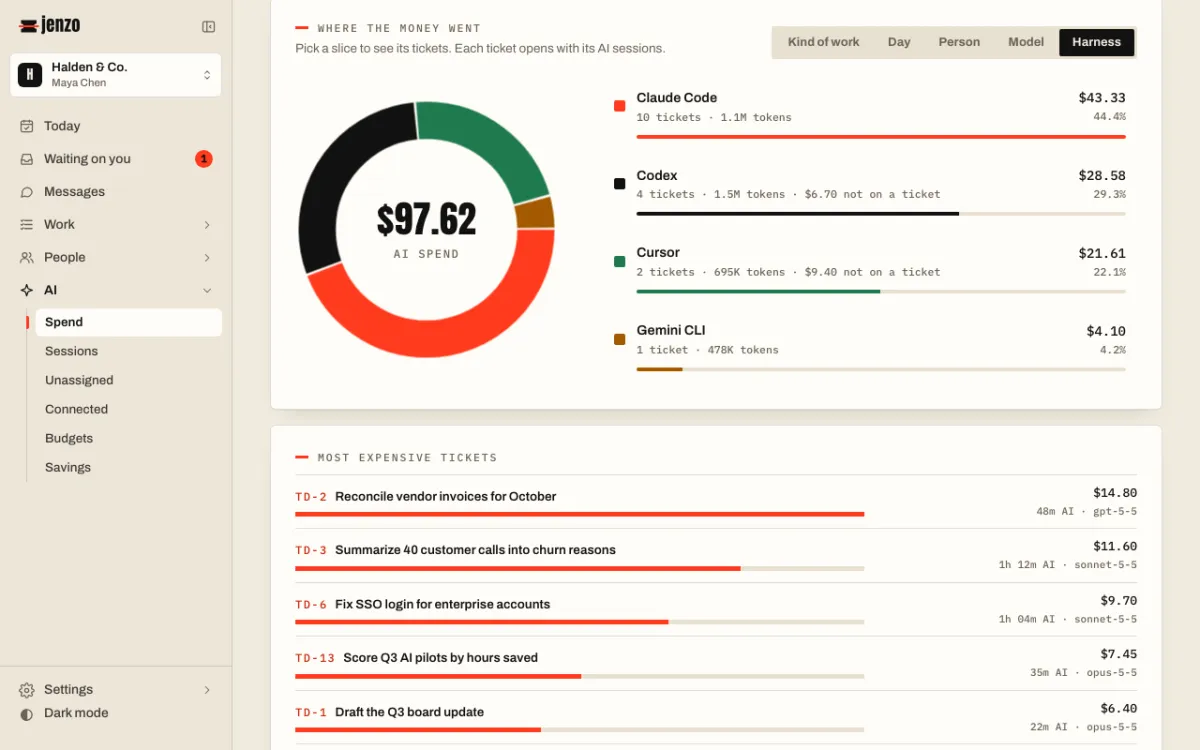
- Cost per finished ticketWhat each piece of shipped work cost in tokens and dollars. This is the number finance can put next to the value of the work.
- Spend by kind of workBug fixes, features, migrations, reports, research. A per-head cap treats them the same. They are not.
- Spend not on any ticketThe share of AI spend nobody can tie to work. When that share goes down, a cap matters less.
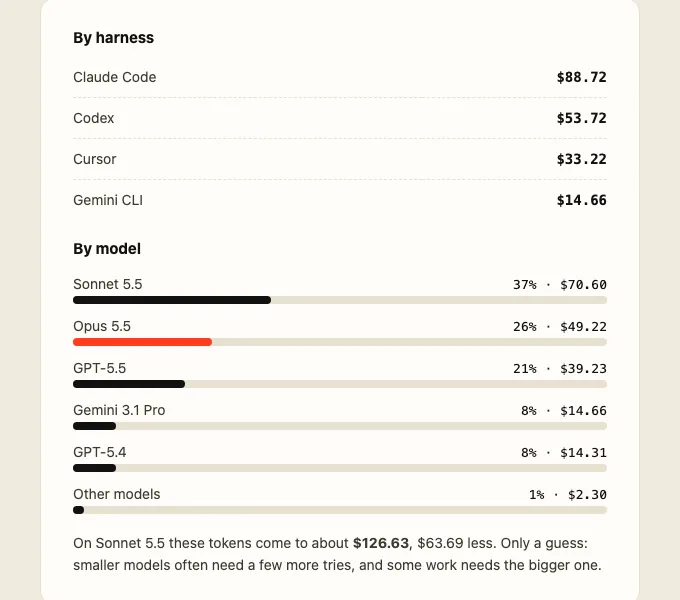
- Model fitWhat the same tokens would have cost on a smaller model. Asking teams to use cheaper models, as Apple did, only works if you can see where the expensive one was wasted.
- The person and their AI on one ticketWho started the run, how long they spent, and how long the AI spent on the same work. Exemptions become easy to judge when they point at named work.
If you still need a cap
Sometimes a ceiling is the right call while you get visibility. Make it a smarter one:
Measure for a month before you set it
Look at what each kind of ticket costs, then set the ceiling from that. A number picked before measuring is a guess with a policy attached.
Cap per kind of work, not per head
A database migration and a copy change should not share a daily limit. Budget by the work, and the heavy users doing heavy work stop looking like a problem.
Make every exemption point at a ticket
"Over the cap, for this migration" is a request anyone can judge. "Over the cap" is not.
Review the top tickets each week, not the top spenders
The most expensive tickets show you waste and value in one list. A ranking of people turns into a leaderboard, and you have seen how those end.
Methodology
What counts as a cap
A limit a company set, or said it would set, on what employees can spend on AI models or AI coding tools. We include on-the-record statements that caps are coming, and companies that say they have none, because both shape the debate.
Sources
Every row links to the outlets that reported it. Several originals (Bloomberg, The Information) are paywalled, so we link the reputable outlets that reported their findings and name the original in the status column. We quote only what those pages say. Where reports conflict, as with Amazon, the status column says so.
The monthly figure
Daily caps are multiplied by 21 working days and weekly caps by 52 weeks divided by 12. These are ceilings if someone used every dollar, not what anyone spent.
Plan prices
The $200 top plan price comes from our AI coding price index, checked against each vendor's pricing page.
Updates
We add a row when a new cap is reported by a named outlet, and change the date at the top.
Cite this page
Jenzo Research (2026). AI spend caps in 2026: Apple, Uber, Tesla, Meta. https://jenzo.ai/research/ai-spend-caps (updated 14 Nov 2026).
Free to quote with a link to this page.
Questions
Did Apple cut its employees' AI budgets?
Yes. Bloomberg reported on 4 November 2026 that in October Apple cut some engineers' daily AI spending limit from $300 to $200, and that some may go down to $100. Many non-engineering groups were already at $100 a day. Some teams were asked to use cheaper models or models that run on the device, and exemptions go through senior leadership.
How much can an Apple engineer spend on AI per day?
Some Apple engineers now have a $200 a day cap, down from $300, according to Bloomberg's report. Used every working day, that is about $4,200 a month, or 21 times the $200 monthly price of the top Claude, Cursor or Devin plan. Reports also said few engineers were using their full $300.
Which companies cap employee AI spending?
On the record in 2026: Apple ($200 or $100 a day for many teams), Uber ($1,500 a month per AI coding tool for all employees) and Tesla ($200 a week, reported by The Information). Meta's Adam Mosseri has said caps will probably be needed. Amazon says it has not capped token usage, but calls token counts a deeply flawed measure of AI work.
Do AI spending caps work?
They stop the bill from growing, which is what they are for. They do not tell you what the money bought. A cap sees who spent and how much on which day. It cannot see which ticket the spend was for, whether that work shipped, or whether a smaller model would have done the same job. Measure cost per finished ticket first, then cap with that data.
What is a reasonable AI budget per engineer?
There is no honest single number. The caps on record run from about $867 a month (Tesla) to $4,200 (Apple's new engineer cap over 21 working days), while the top plans of Claude, Cursor and Devin list at $200 a month. Spend inside one team is usually lopsided, so a per-head average misleads. Set budgets per kind of work after a month of measuring what each kind of ticket costs.
How do I see AI spend per ticket instead of per person?
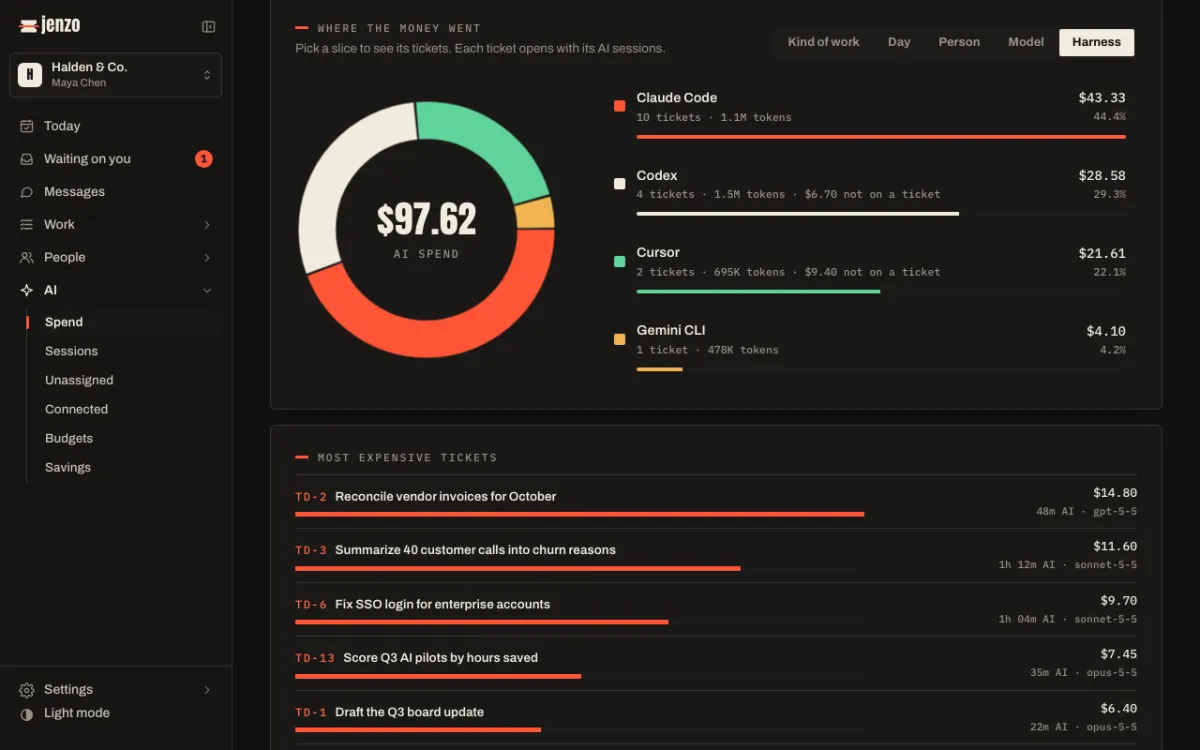
Log every AI session against the ticket it worked on, with its tokens, model and cost. Jenzo does this for Claude Code, Codex and Cursor: each ticket shows what its AI work cost, and the Spend view breaks the total down by kind of work, person, model and tool.