

AI spend management in 7 numbers
AI spend management comes down to one monthly question: what did the AI bill buy? Provider dashboards and spend platforms answer by vendor, API key and person. For AI coding tools like Claude Code, Codex and Cursor, the useful unit is the work: the ticket each session was for. Here are the seven numbers to put on one page, what each one answers, and where it comes from.
The fastest-growing line nobody can explain
Token bills used to be an engineering detail. Now they reach the CFO. Enterprises in Accenture's survey spent roughly $2.5 billion on AI tokens last year and expect consumption to grow 78% over the next 24 months. The complaint is the same everywhere: a big number, a graph that goes up, and no way to say what it paid for. In the words of the people holding the budget:
My token cost from cloud code is shooting through the roof
Lan Guan, chief AI and data officer at Accenture, in Fortune
Finance teams above all else value predictability. Token spend is the opposite of predictable.
A Hacker News commenter
Most engineering teams I've talked to have no idea what their AI spend is per developer because it's buried in a consolidated cloud bill.
A Hacker News commenter
How are you budgeting for AI spend? ... how do you even pressure test that forecast?
r/CFO
The 7 numbers, one per line
Each line answers a question finance actually asks. Values are from Jenzo's demo workspace, a 40-person services firm, for one month. Your own scorecard comes from the same screens.
Total AI spend, every tool
What did AI cost us this month, across Claude Code, Codex, Cursor and Gemini CLI, on seats and on API keys?
In Jenzo: AI page, month viewShare that is measured
How much of that number was read from real usage, and how much did the AI report about itself?
In Jenzo: Measured or estimated, per rowShare on a ticket
How much of the spend can we tie to a piece of work at all?
In Jenzo: Not on a ticket lineSpend by type of work
What did the money buy: bug fixes, research, ops, writing?
In Jenzo: Spend by kind of workCost per ticket, by type
What does one finished piece of work cost, and which kinds are expensive?
In Jenzo: Spend by kind of workTop-model spend and model fit
How much went to the most expensive models, and where would a cheaper one have done?
In Jenzo: Model routing savingsSpend against budget
Which team, project or client is over, and who has been told?
In Jenzo: Budgets- Lines 2 and 3 decide whether to trust the rest. If half the spend is estimated or on no ticket, fix that before you read lines 4 to 7.
- Line 5 is the unit finance can plan with. In the demo, a writing ticket cost $1.44 of AI and a planning ticket $4.30. A per-person average hides that.
- Line 6 is the quickest saving. $49.22 went to top-tier models; the same tokens on Sonnet would have cost $24.61 less, $4.55 of it on summaries and file renames. An estimate, since a cheaper model would not use exactly the same tokens.
Where each number lives
No new dashboard to build. The scorecard is four screens a Jenzo admin already has, shown here for the demo month in light and dark.
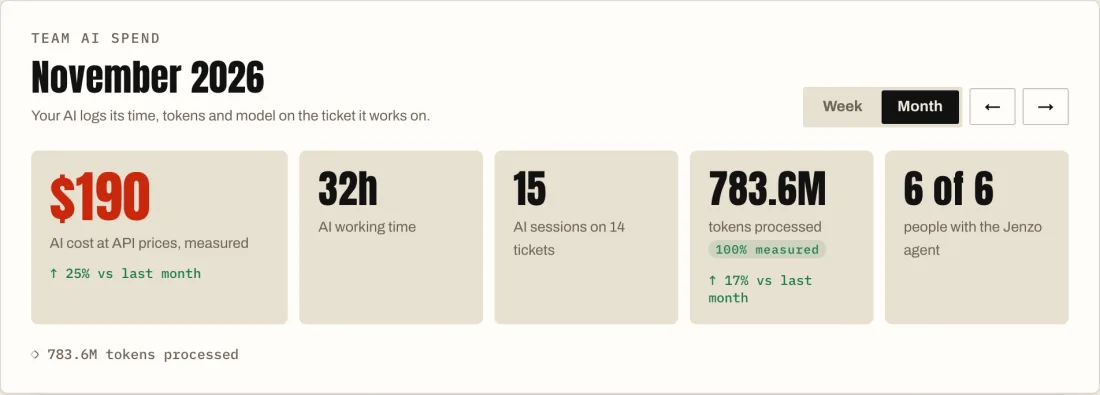
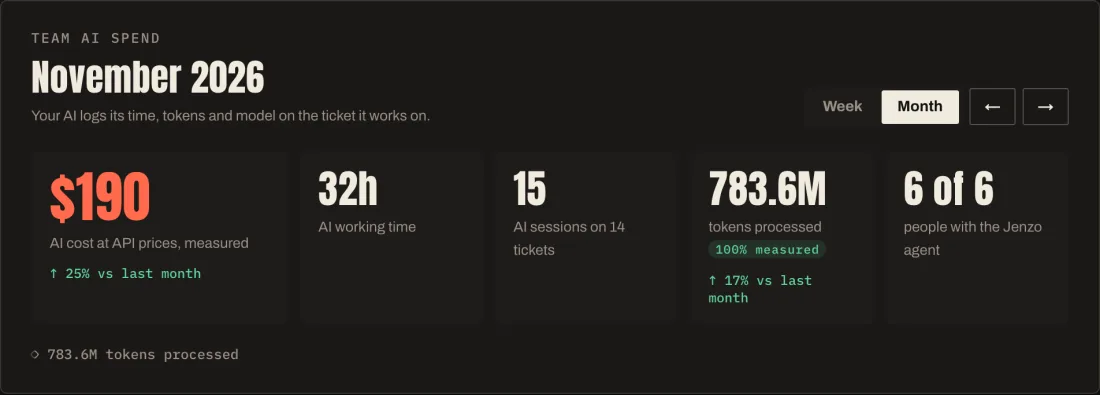
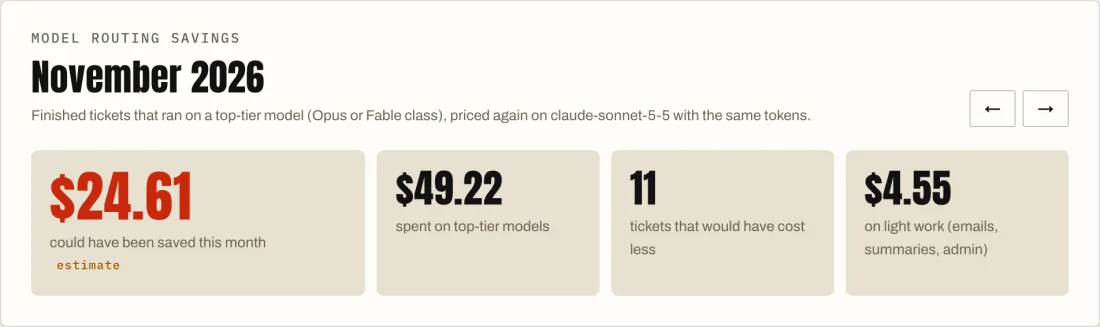
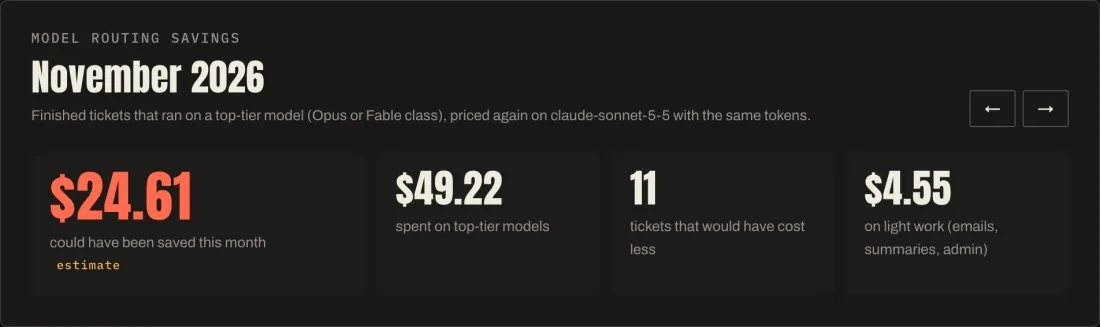
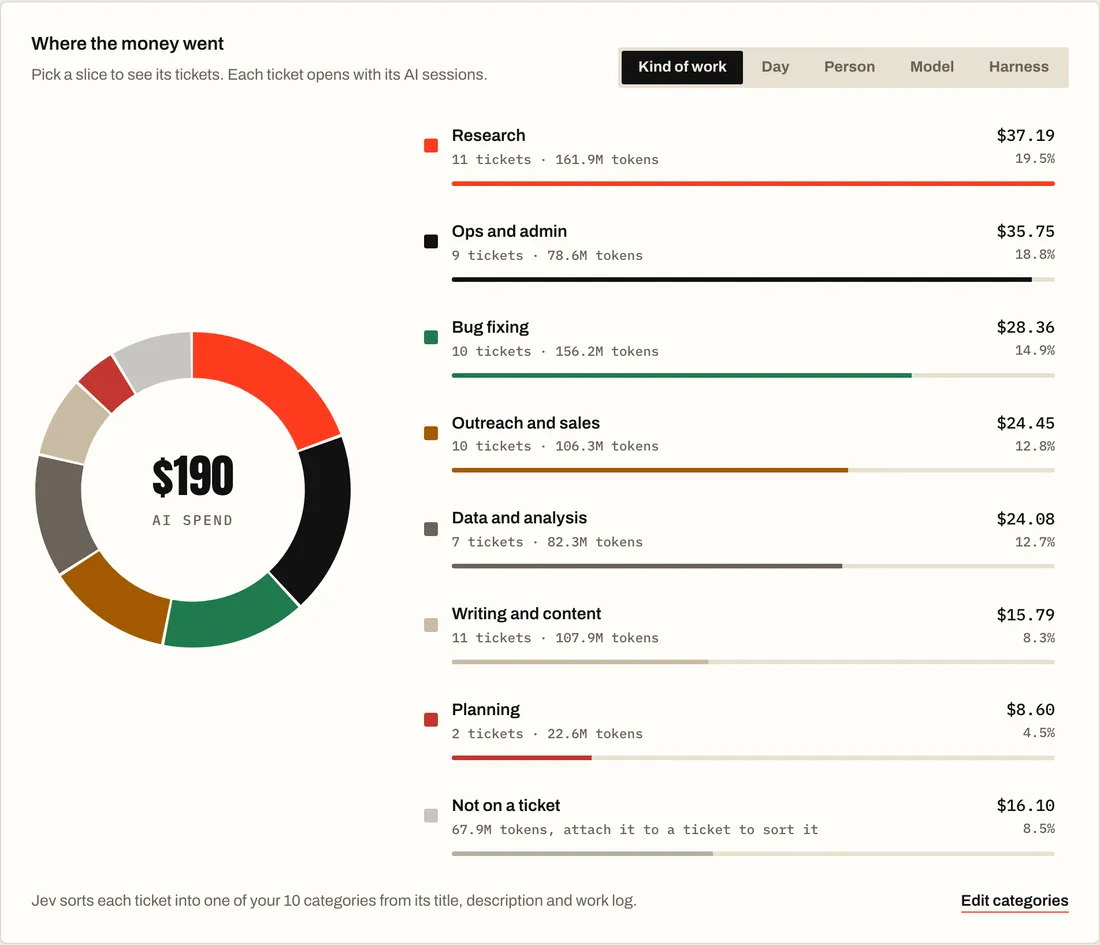
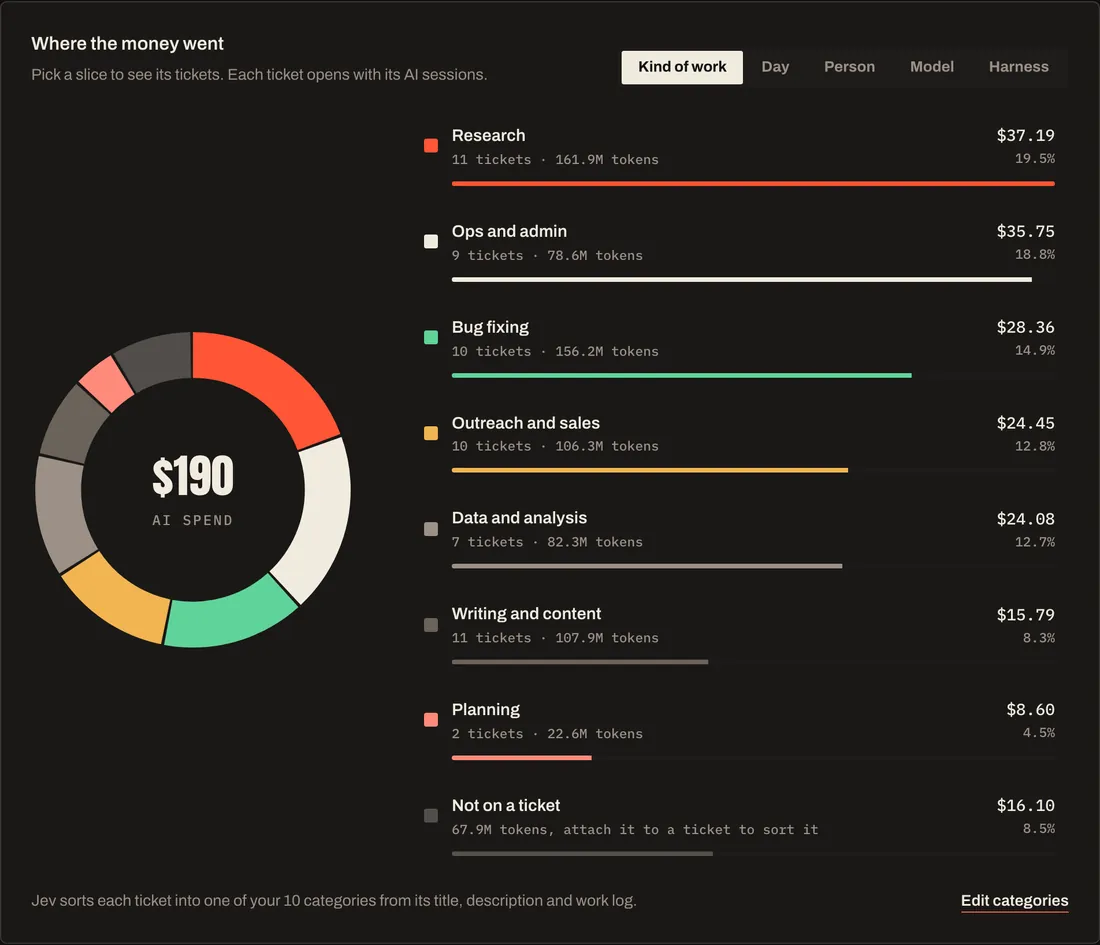
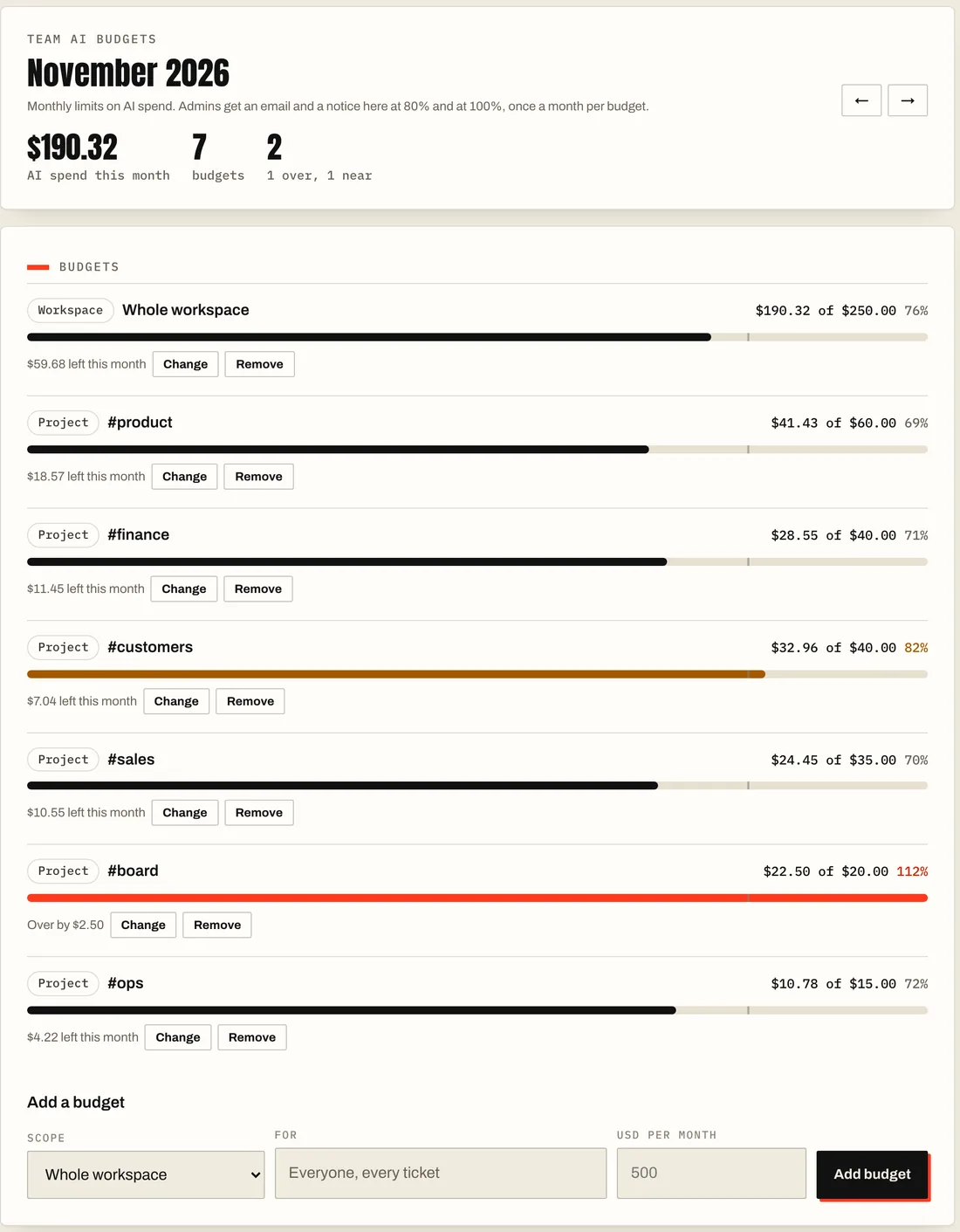
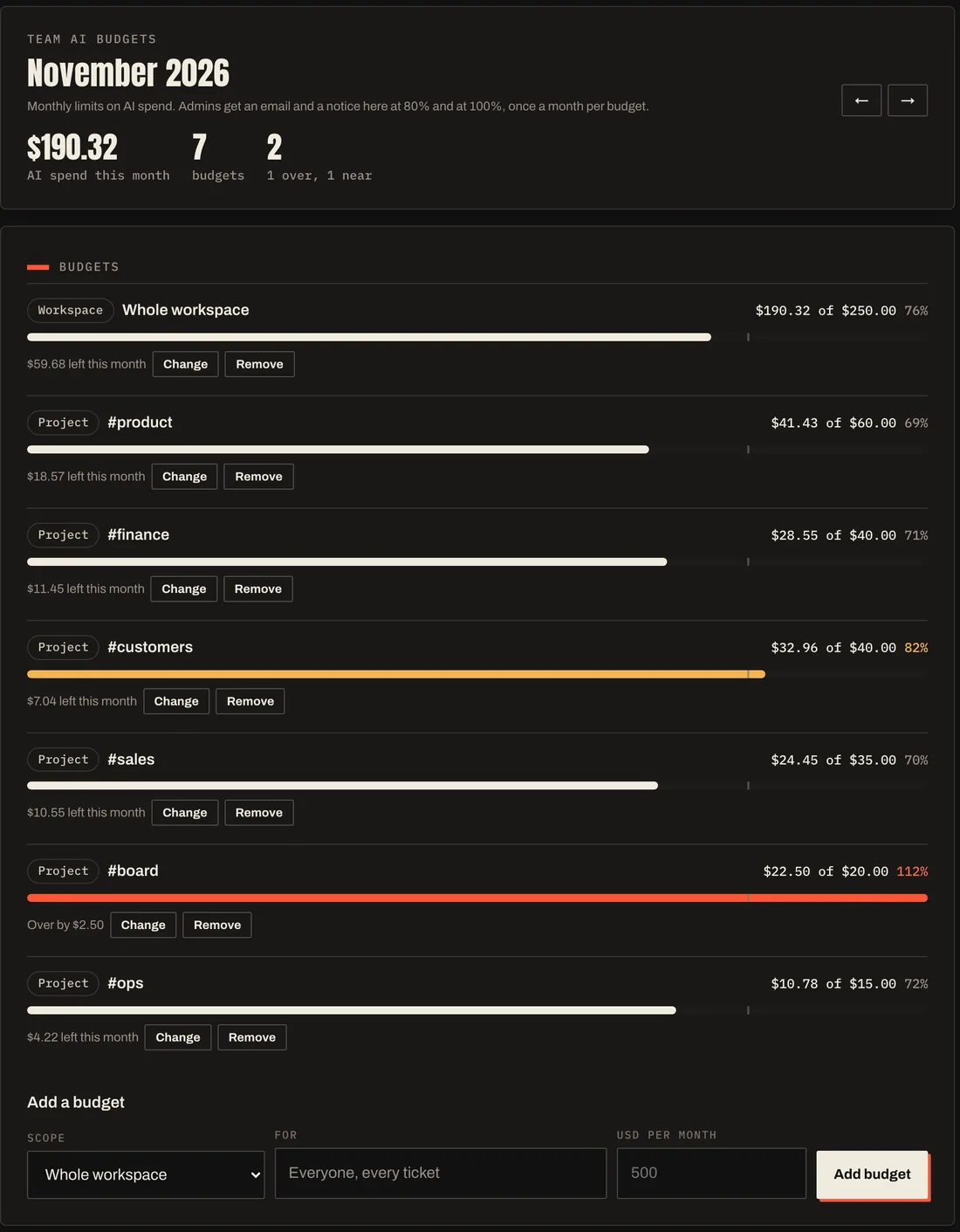
Demo workspace, not customer data. Project budgets are on the Business plan.
What to leave off the page
Three numbers show up in most AI dashboards and none of them tells finance what the money bought.
Tokens per person
A cost input, not an outcome. Rank people by it and you pay for the ranking. Amazon dropped its token leaderboard; The Next Web reports it now calls token use, adoption and code changes "deeply flawed" measures.
Adoption rate
Seats used says the tool is open on a screen. It says nothing about what the spend got done. Mandated usage inflates it, and it drops again when the mandate does.
Caps as the metric
A daily cap tells you who hit the limit, not what the money bought. Apple's 2026 cuts are covered in the AI spend cap wave. Use budgets per project with an owner instead.
Forecast from the backlog, not last month's bill
A trend line on the bill only says spend went up. Once you know cost per ticket by type of work, the backlog becomes the forecast: the work you plan to do, priced at what that kind of work has cost you.
Worked example with the demo month's rates and a made-up backlog. 91.5% of the month's spend was on a ticket, so the subtotal is divided by 0.915:
List-price dollars. Apply your invoice ratio to turn them into what you will pay, as on AI chargeback. To try it with your own numbers, use the AI budget worksheet.
Method: list price, measured and estimated
Jenzo prices every session at the model's published API rate. That gives one unit across subscription seats, API keys and tools, but it is not your invoice: on Claude subscription plans, Anthropic's own cost docs say the session cost "isn't relevant for billing purposes." Claude Code, Codex and Gemini CLI usage is measured from the session files on the computer by the Jenzo plugin or agent. Cursor keeps no token counts on disk, so Cursor sessions report their own, and those rows are marked estimated, which is why line 2 exists. More in the cost per ticket method.
AI spend management tools, compared
Each kind of tool sees a different slice. If most of your AI spend is your product calling models through API keys, a spend platform or gateway fits well. If it is people working with AI coding tools on seats, the ticket is where the cost and the purpose meet. Many teams will use both.
| Approach | Examples | What it sees | What it misses |
|---|---|---|---|
| Provider consoles | Anthropic Console, Claude Code analytics, Cursor admin | One vendor at a time, by user, API key or workspace | The other vendors, and which work a session was for. Anthropic's Claude Code Analytics API does not return subscription-plan usage |
| AI spend platforms | Ramp AI Spend Management | Spend across providers by provider, model, project, API key and user; limits with notices at 50%, 75% and 100%; spend by task in early access | Claude Team, ChatGPT Business and personal plans, which Ramp's FAQ says lack the usage data it needs |
| Cloud FinOps platforms | Vantage, CloudZero | Provider bills next to cloud spend; Claude Enterprise usage by user and product | The unit of work. Team splits need tagged keys or your own telemetry |
| AI gateways | LiteLLM, Portkey | Every call routed through the gateway, by key, team or metadata tag | Coding tools on seats that do not route through it |
| Spend on the ticket | Jenzo | Every AI session on the ticket it worked on, seat or key, across Claude Code, Codex, Cursor and Gemini CLI, by type of work, project and person | AI work no tool reported. It alerts on budgets but does not hard-cap or pay bills, and dollars are list price |
Checked on each vendor's own pages, November 2026: Ramp AI Spend Management, Claude Code Analytics API. Details for the others are on AI chargeback.
How it works
Connect the tools
Add the Jenzo MCP to Claude Code with claude mcp add jenzo. Codex, Cursor and Gemini CLI connect the same way.
Work on tickets
Each AI session records its ticket, model, tokens and time, so every dollar lands on a piece of work with a type and a project.
Read the seven numbers
The AI page, Spend by kind of work, Savings and Budgets hold the scorecard. The open API and the CSV export feed your own model.
Each line in depth: AI coding cost per ticket, AI usage by type of work, AI chargeback and Claude Code usage per developer. Current plan prices: the AI coding price index.
Cite this page
Jenzo (2026). AI spend management for AI coding tools: the CFO's 7-number scorecard. https://jenzo.ai/ai-spend-management.
Free to quote with a link to this page.
Questions
What is AI spend management?
AI spend management is seeing, explaining and controlling what a company spends on AI: model APIs, AI coding tools such as Claude Code, Codex and Cursor, and chat seats. In practice it means one total across providers, a split the business understands, budgets with owners, and a check on where an expensive model was not needed. Some search results use the phrase for AI-powered expense software, which is a different product.
What is the difference between AI spend management and AI cost management?
They are used for the same job. AI cost management is the more common term in FinOps and cloud teams, and usually covers tracking, attributing, controlling and optimizing AI costs. AI spend management is the finance team's word for it. Both should end in the same report: what the AI bill bought.
What should a CFO track for AI coding tools?
Seven numbers, one per line: total AI spend across every tool, the share of it that is measured, the share tied to a ticket, spend by type of work, cost per ticket by type, top-model spend with an estimate of what a cheaper model would have cost, and spend against budget per team, project or client.
Why not track tokens per person?
Tokens are a cost input, not an outcome. Ranking people by tokens rewards waste: Amazon shut an internal token leaderboard and now tells engineers that token use does not equal better work. Tie spend to the work it bought instead, then look at people only when a ticket's cost looks wrong.
Are the dollars in Jenzo our actual AI invoice?
No. Jenzo prices every session at the model's published API rate, which gives one comparable unit across seats, API keys and tools. On subscription plans that is not what you pay. Use the figures as shares and apply them to the real invoice, as shown on the AI chargeback page.
How do we forecast AI spend for next quarter?
Forecast from the work, not from last month's bill. Count the open tickets by type of work, multiply each by that type's cost per ticket, then divide by the share of spend that lands on a ticket to cover the rest. It is a spreadsheet on top of Jenzo's export, not a Jenzo screen, and it gets better each month you have real data.
Does this work on Claude Pro, Max or Team seats?
Yes. Jenzo works from the session: each Claude Code, Codex, Cursor or Gemini CLI session records the ticket it worked on, whether it ran on a subscription seat or an API key. Claude Code usage is measured by the Jenzo plugin; other tools report their own tokens, and those rows are marked estimated.